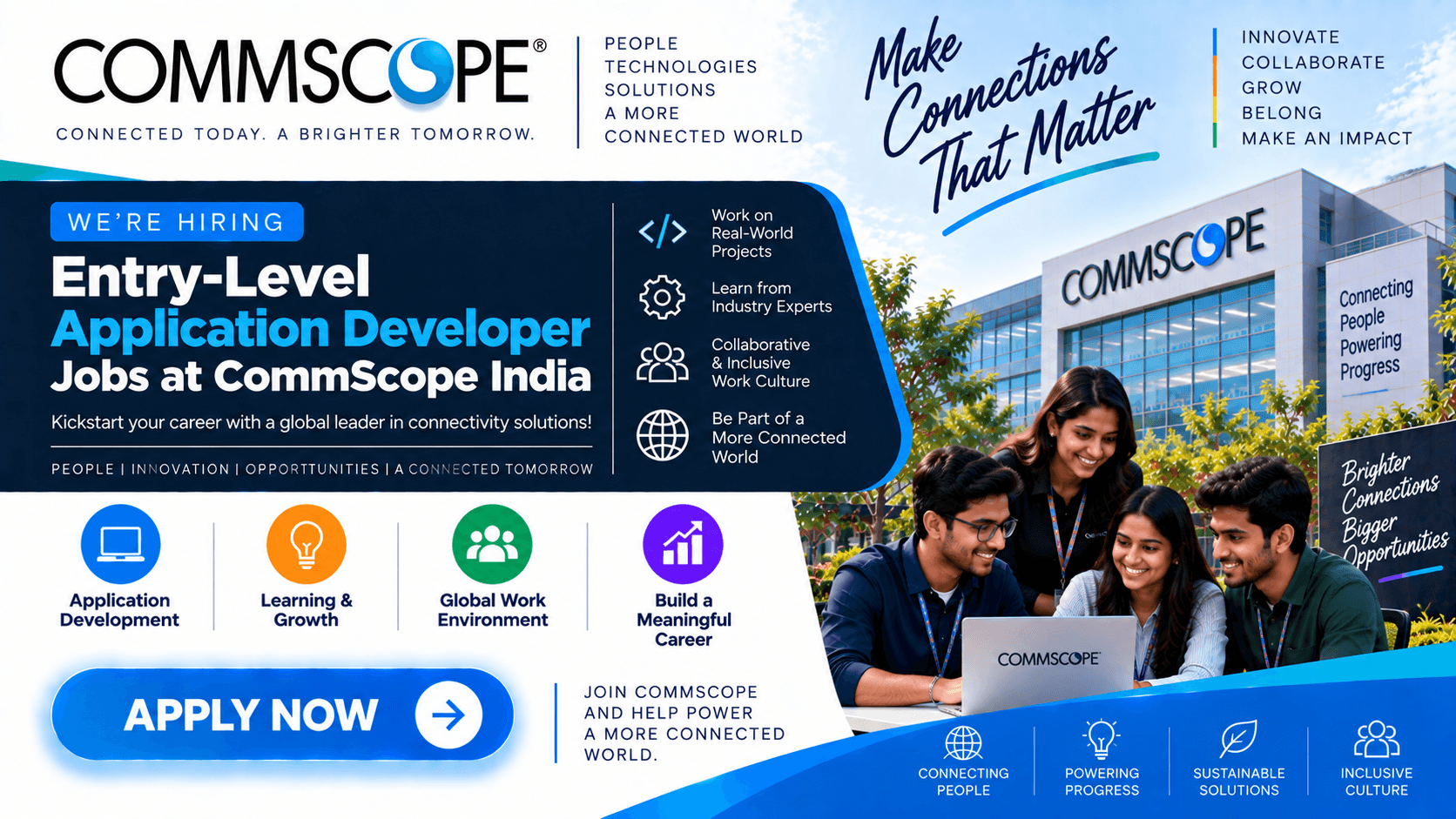
Application Developer at Commscope | India
Commscope, a leader in connectivity and network infrastructure solutions, is actively hiring Application Developers across India for office-based roles. This is an excellent opportunity for B.Tech/M.Tech graduates and early-career IT professionals (0-5 YoE) to join a global tech organization and contribute to enterprise-scale software applications. If you have a solid foundation in object-oriented programming, database design, and modern development frameworks, this role offers meaningful exposure to real-world application architecture and deployment pipelines. Stay competitive in the job market—join our WhatsApp and Telegram channels below for free daily IT job alerts, referral opportunities, and walk-in updates.
Table of Contents
- Job Details
- About Commscope
- Job Description
- Eligibility Criteria
- Key Responsibilities
- Required Skills
- Who Can Apply
- How to Prepare
- Frequently Asked Questions
- How to Apply
- Stay Updated — Free Job Alerts
- Disclaimer
Job Details
| Field | Value |
|---|---|
| Company | Commscope |
| Job Title / Role | Application Developer |
| Qualification | B.Tech / M.Tech in Computer Science, IT, or related discipline |
| Experience | 0–5 years (entry to junior-level) |
| Salary / CTC | As per company standards |
| Location | India (work-from-office) |
| Work Model | Office-based |
| Job Type | Full-time |
| Application Deadline | As per company standards |
About Commscope
Commscope is a global leader in delivering essential connectivity and network infrastructure solutions. The company serves enterprise, service provider, and hyperscale data center customers worldwide with innovative software, hardware, and service offerings. Commscope operates across multiple verticals including networking, cloud infrastructure, and software-defined solutions, employing thousands of engineers and technical professionals across global R&D centers. The organization is committed to fostering a culture of innovation, collaboration, and continuous learning, making it an attractive destination for early-career developers seeking exposure to large-scale system design and enterprise-grade application development. With strong market presence and a track record of technical excellence, Commscope provides a structured environment for career growth and skill advancement in software development.
Job Description
The Application Developer role at Commscope involves designing, developing, and maintaining enterprise applications that support the company’s infrastructure and connectivity solutions. You will work with modern programming languages, web frameworks, and cloud technologies to build scalable, reliable software systems. This position is ideal for developers who enjoy both backend and frontend development and want to understand how applications integrate with network and infrastructure systems.
As an Application Developer, you will be part of a collaborative engineering team working on mission-critical applications used by customers globally. You will participate in the full software development lifecycle—from requirement analysis and design to coding, testing, deployment, and maintenance. Your day-to-day activities will include writing clean, maintainable code, reviewing peer code, debugging production issues, and optimizing application performance. You will also interact with cross-functional teams including network architects, quality assurance engineers, and product managers to deliver solutions that align with business objectives.
This role emphasizes hands-on coding, problem-solving, and a growth mindset. You will have opportunities to learn new technologies, contribute to open-source initiatives (if applicable within the organization), and develop both technical depth and breadth. The office-based work model ensures regular mentorship and knowledge-sharing with senior engineers, making it an excellent stepping stone for freshers and junior developers transitioning into professional software engineering roles.
Eligibility Criteria
- Education (Mandatory): Bachelor’s degree (B.Tech/B.E.) or Master’s degree (M.Tech) in Computer Science, Information Technology, Software Engineering, or a closely related discipline from a recognized institution.
- Experience (Preferred): 0–5 years of professional software development experience. Entry-level graduates without formal experience but with strong academic projects and competitive programming background are encouraged to apply.
- Programming Foundation (Mandatory): Solid understanding of object-oriented programming (OOP) principles and at least one mainstream programming language such as Java, Python, C++, or C#.
- Database Knowledge (Mandatory): Basic understanding of relational databases (SQL) and familiarity with database design concepts like normalization, indexing, and query optimization.
- Web Technologies (Preferred): Familiarity with HTML, CSS, JavaScript, and modern web frameworks such as React, Angular, or Vue.js is a plus.
- Version Control (Preferred): Hands-on experience with Git or similar version control systems; GitHub profile with sample projects is advantageous.
- Communication & Teamwork (Mandatory): Strong verbal and written communication in English; ability to work effectively in Agile/Scrum teams and articulate technical ideas clearly.
- Problem-Solving Mindset: Demonstrated ability to debug, troubleshoot, and optimize code; comfort with learning new tools and frameworks quickly.
Key Responsibilities
- Full-Stack Application Development: Design and develop scalable applications using assigned programming languages and frameworks, adhering to coding standards and architectural patterns set by the team.
- Code Review & Quality Assurance: Participate in peer code reviews, write comprehensive unit tests, and collaborate with QA teams to ensure code quality, test coverage, and adherence to security best practices.
- Database Design & Optimization: Design efficient database schemas, write optimized SQL queries, and work with database administrators to ensure data integrity and performance.
- Troubleshooting & Debugging: Identify and resolve production bugs, analyze logs, and implement fixes with minimal downtime; contribute to incident management and post-mortems.
- Documentation & Knowledge Transfer: Create clear technical documentation, API specifications, and design documents; mentor junior team members and share knowledge through team presentations.
- Integration & Deployment: Work with CI/CD pipelines, containerization tools (Docker, Kubernetes), and cloud platforms (AWS, Azure) to deploy and monitor applications in staging and production environments.
- Agile Collaboration: Participate in sprint planning, daily standups, retrospectives, and iterative development cycles; actively communicate blockers and progress to team leads and product owners.
- Performance Optimization: Profile applications, identify bottlenecks, and implement optimization techniques to improve response times, memory usage, and throughput.
Required Skills
- Java / Python / C# / C++ — Core programming language used for backend and application logic development; experience with at least one is mandatory for this role.
- Object-Oriented Programming (OOP) — Solid grasp of encapsulation, inheritance, polymorphism, and design patterns (Singleton, Factory, MVC, etc.) to write maintainable, scalable code.
- Relational Databases & SQL — Ability to design schemas, write and optimize queries, understand indexing, transactions, and basic database tuning concepts.
- Web Technologies (HTML, CSS, JavaScript) — Foundational knowledge of front-end technologies; experience with modern frameworks like React, Angular, or Vue.js is valuable for full-stack roles.
- REST API Design & Microservices — Understanding of RESTful architecture, HTTP methods, API versioning, and basics of microservices-based application design.
- Version Control (Git) — Proficiency with Git commands, branching strategies, and collaborative development workflows; GitHub experience is beneficial.
- Basic DevOps & Cloud Knowledge — Familiarity with containerization (Docker), container orchestration (Kubernetes basics), and cloud platforms (AWS, Azure, GCP) is a plus.
- Testing & Debugging — Ability to write unit tests using frameworks like JUnit, NUnit, or pytest; experience with debugging tools and log analysis.
- Problem-Solving & Analytical Thinking — Capacity to break down complex problems, analyze requirements, and design efficient solutions with minimal guidance.
- Communication & Documentation — Clear written and verbal communication in English; ability to document code, design decisions, and technical processes for team reference.
- Agile & Scrum Methodology — Understanding of sprint cycles, user stories, estimation, and collaborative team dynamics in an Agile environment.
Who Can Apply
This role is ideal for fresh B.Tech/M.Tech graduates and junior developers (0–5 YoE) looking to establish a career in enterprise software development. If you have a strong academic foundation in computer science, hands-on experience with at least one modern programming language, and genuine interest in building scalable applications, you are a good fit. The role welcomes early-career developers who are eager to learn, collaborate with senior engineers, and grow their technical skills in a structured, mentorship-rich environment.
- Entry-level candidates: Fresh graduates with excellent academic performance, competitive programming background, and 1–2 solid academic/personal projects showcasing OOP and database concepts.
- Junior developers (1–3 YoE): Professionals with experience in any mainstream programming language and exposure to web development or database design; no specific technology stack preference required.
- Career switchers: Candidates transitioning into software development from other engineering disciplines, provided they have strong programming fundamentals and can demonstrate capability through projects or assessments.
- Not ideal for: Developers seeking only front-end specialization without willingness to learn backend technologies, or those unwilling to work in an office-based environment.
How to Prepare
- Master Core Data Structures & Algorithms: Practice arrays, linked lists, stacks, queues, trees, graphs, sorting, searching, and dynamic programming on platforms like LeetCode, HackerRank, or CodeSignal; aim to solve medium-level problems confidently in your preferred language.
- Strengthen OOP Concepts: Study and implement design patterns (Singleton, Factory, Observer, Strategy); understand SOLID principles; practice writing extensible and maintainable code through personal projects.
- SQL & Database Design: Learn relational database concepts, write complex SQL queries (JOINs, subqueries, window functions), understand normalization, indexing, and query optimization; practice on platforms like LeetCode Database or Mode Analytics.
- Build a Real Project: Develop an end-to-end application (e.g., e-commerce system, task management app, or social media feed) using your chosen language, a web framework, and a SQL database; host on GitHub with clear documentation and README.
- Web Fundamentals: Solidify understanding of HTTP/HTTPS, REST APIs, request-response cycles, status codes, and basic front-end technologies (HTML, CSS, JavaScript); experiment with a lightweight web framework like Flask (Python) or Spring Boot (Java).
- Version Control Mastery: Become fluent in Git; practice branching, merging, rebasing, and conflict resolution; maintain an active GitHub profile with well-documented projects and meaningful commit messages.
- System Design Basics: Study scalability, load balancing, caching, microservices, and containerization at a foundational level; read articles or watch videos on how large systems are architected.
- Mock Interviews & Technical Discussions: Participate in mock interviews on platforms like Pramp or Interviewing.io; practice explaining your projects, walking through code, and discussing design trade-offs with clarity and confidence.
- Agile & Team Collaboration: Familiarize yourself with Agile terminology (sprints, user stories, backlog, velocity); practice collaborative coding using pair programming or contributing to open-source projects on GitHub.
- DevOps & Cloud Exposure: Get hands-on with Docker, write a simple Dockerfile for one of your projects; explore free-tier options on AWS or Azure to deploy applications; understand basics of CI/CD pipelines.
- Resume & Portfolio Building: Create a polished resume highlighting projects, skills, and any internships; curate your GitHub portfolio with 3–4 well-structured projects; write brief READMEs explaining your contributions and learnings.
- Communication Practice: Practice explaining technical concepts in simple terms; articulate your problem-solving approach during mock interviews; review your written communication in emails and documentation.
Frequently Asked Questions
1. What is the exact salary offered for the Application Developer role at Commscope?
Salary details are not specified in the official job posting. Compensation is determined based on qualifications, experience, educational background, and current market conditions. We recommend contacting Commscope’s HR team directly via the application link for precise salary information.
2. Is this role open for fresh graduates with no prior work experience?
Yes, this role welcomes freshers with strong academic credentials, solid OOP fundamentals, and demonstrated programming capability through academic projects or competitive programming. Candidates without formal experience should have 1–2 substantial projects showcasing full-stack development, database design, and problem-solving skills.
3. What programming languages does Commscope expect applicants to know?
The job does not specify a mandatory language. However, proficiency in Java, Python, C#, or C++ is highly valued. Any mainstream object-oriented language is acceptable as long as you can demonstrate strong fundamentals and the ability to learn other languages quickly.
4. Do I need to have cloud platform experience (AWS, Azure, GCP)?
Cloud experience is preferred but not mandatory for entry-level candidates. However, learning Docker and basic Kubernetes concepts, and having at least beginner-level exposure to one cloud platform, will strengthen your application significantly.
5. Is frontend development experience required for this role?
Frontend experience (React, Angular, Vue.js) is preferred, particularly for full-stack roles. However, strong backend fundamentals and willingness to learn frontend technologies are often sufficient. Clarify with the recruiter whether the role is purely backend, full-stack, or frontend-focused.
6. What is the work schedule and work-from-home policy?
This is explicitly an office-based role. You will be required to work from the office location in India. There is no mention of hybrid or work-from-home flexibility in the job posting. Confirm office location and any flexibility options directly with Commscope HR.
7. How long does the hiring process typically take at Commscope?
Hiring timelines vary by company and open position. Typically, large companies like Commscope follow a multi-stage process: online coding assessment, technical interview(s), HR interview, and background verification, which can span 2–6 weeks. Monitor your email regularly for updates.
8. Do I need to be GATE qualified or have a high CGPA to apply?
GATE qualification and CGPA thresholds are not mentioned in the job posting. However, a strong academic record (typically 7.0+ CGPA) demonstrates discipline and learning aptitude, which helps during shortlisting. Focus on your skills, projects, and problem-solving ability rather than a single metric.
9. Is there an application deadline for this position?
A specific application deadline is not mentioned in the posting. We recommend applying as soon as possible, as tech roles often fill quickly. Engage with your recruiter or contact Commscope directly to confirm the deadline for this role.
10. What is the typical career progression for an Application Developer at Commscope?
While not detailed in this job posting, typical progression in large tech companies includes: Senior Developer → Technical Lead → Manager → Director. Progression depends on performance, additional skills (cloud, architecture, leadership), and internal opportunities. Request clarification on career growth prospects during interviews.
11. How many rounds of interviews should I expect?
The interview structure is not specified in the job posting. Typical IT company processes include: coding round (online assessment or take-home), technical interview(s) with engineers, system design discussion, and HR/behavioral interview. Prepare for 2–4 rounds over a span of 2–4 weeks.
12. Will there be an online coding assessment or only technical interviews?
Assessment format details are not provided in the job posting. Most tech companies use online coding assessments (on platforms like HackerEarth, HackerRank, or CodeSignal) for initial screening, followed by technical and HR interviews. Confirm with the recruiter after application.
13. What is the office location for this role in India?
The job posting states “India” but does not specify a particular city. Commscope has offices in multiple cities including Bangalore, Hyderabad, Pune, and Delhi. Clarify the exact office location when applying or during the first recruiter call.
14. Are there relocation benefits if I need to move for the role?
Relocation and joining benefits are not mentioned in the job posting. These are typically negotiable during offer stage. Discuss relocation support, joining bonus, and other benefits during the HR round.
15. What does a typical day look like for an Application Developer at Commscope?
A typical day includes: standup meetings with your team, coding and reviewing peer code, debugging/troubleshooting issues, attending design discussions, testing your code, and attending cross-functional meetings. You will have opportunities for mentoring, learning new technologies, and contributing to architectural decisions as you grow.
16. Do I need to contribute to open-source projects to be considered?
Open-source contributions are not mandatory but are highly valued. Active GitHub profiles with meaningful projects demonstrate initiative, collaboration, and coding discipline. Even contributions to smaller projects show genuine interest in software development.
17. What should I include in my portfolio to stand out?
Include 3–4 projects that showcase different skills: a full-stack web application, a backend microservice with API design, a data-intensive application with optimization, and a project using modern tools (Docker, cloud). Each project should have clear README, documentation, and be deployed live (or with screenshots/demos).
18. Is this role better suited for backend, frontend, or full-stack developers?
The job title and description suggest a general Application Developer role, likely with exposure to both backend and frontend. Early-career candidates are expected to be adaptable and willing to learn across the stack. Specialization typically comes after 2–3 years of experience.
19. Will working at Commscope help me transition into a cloud or DevOps career later?
Yes. Commscope’s infrastructure and connectivity focus exposes you to cloud platforms, containerization, and deployment pipelines. After 2–3 years as an Application Developer, you can specialize in cloud architecture, DevOps, or site reliability engineering (SRE) roles.
20. Should I apply if I have only 6 months of internship experience?
Yes, you should definitely apply. Internship counts as professional experience. If you have strong projects, a solid CGPA, and can articulate learnings from your internship clearly, you are competitive. Frame your internship contributions prominently in your resume and portfolio.
How to Apply
Applying for the Application Developer role at Commscope is straightforward. Follow the steps below to submit your application:
- Visit the official application link provided by reviewing the job posting carefully.
- Create an account or log in using your email address and password (if a portal exists).
- Fill in your personal details, educational background, and work experience accurately.
- Upload your resume (in PDF format), ensuring it is well-formatted, clear, and highlights your projects, skills, and achievements.
- Provide links to your GitHub profile and portfolio (if you have one); include brief descriptions of 2–3 key projects.
- Write a compelling cover letter explaining your interest in the role, relevant skills, and what you can bring to the Commscope team.
- Review all information for accuracy and completeness before submitting.
- Submit your application and note any confirmation number or email sent to you.
- Keep an eye on your email for recruiter communications, coding assessments, or interview invitations.
Application Deadline: Apply as soon as possible; deadlines are not specified but positions may fill quickly.
Stay Updated — Free Job Alerts
Get instant IT job, referral, internship, and walk-in alerts directly to your device:
- WhatsApp Channel: Join our WhatsApp Channel for daily job updates and exclusive referral opportunities.
- Telegram Channel: Join our Telegram Channel for real-time notifications and career resources.
Never miss an opportunity—subscribe to both channels and stay ahead in your job search!
Disclaimer
This article is for informational purposes only. Job details, qualifications, and application procedures are sourced from publicly available listings and official job postings. This information may change at any time without notice. Always verify the role, eligibility criteria, application deadline, and other details on the official Commscope website or career portal before submitting your application. itreferraljobs.in does not charge any fee for job referrals, applications, or career guidance. We strongly advise candidates to be cautious of fraudulent recruitment agents or unofficial portals claiming to guarantee job placements.